
Content Updated : June 29, 2026
Garden Orb Spider: Everything You Need to Know
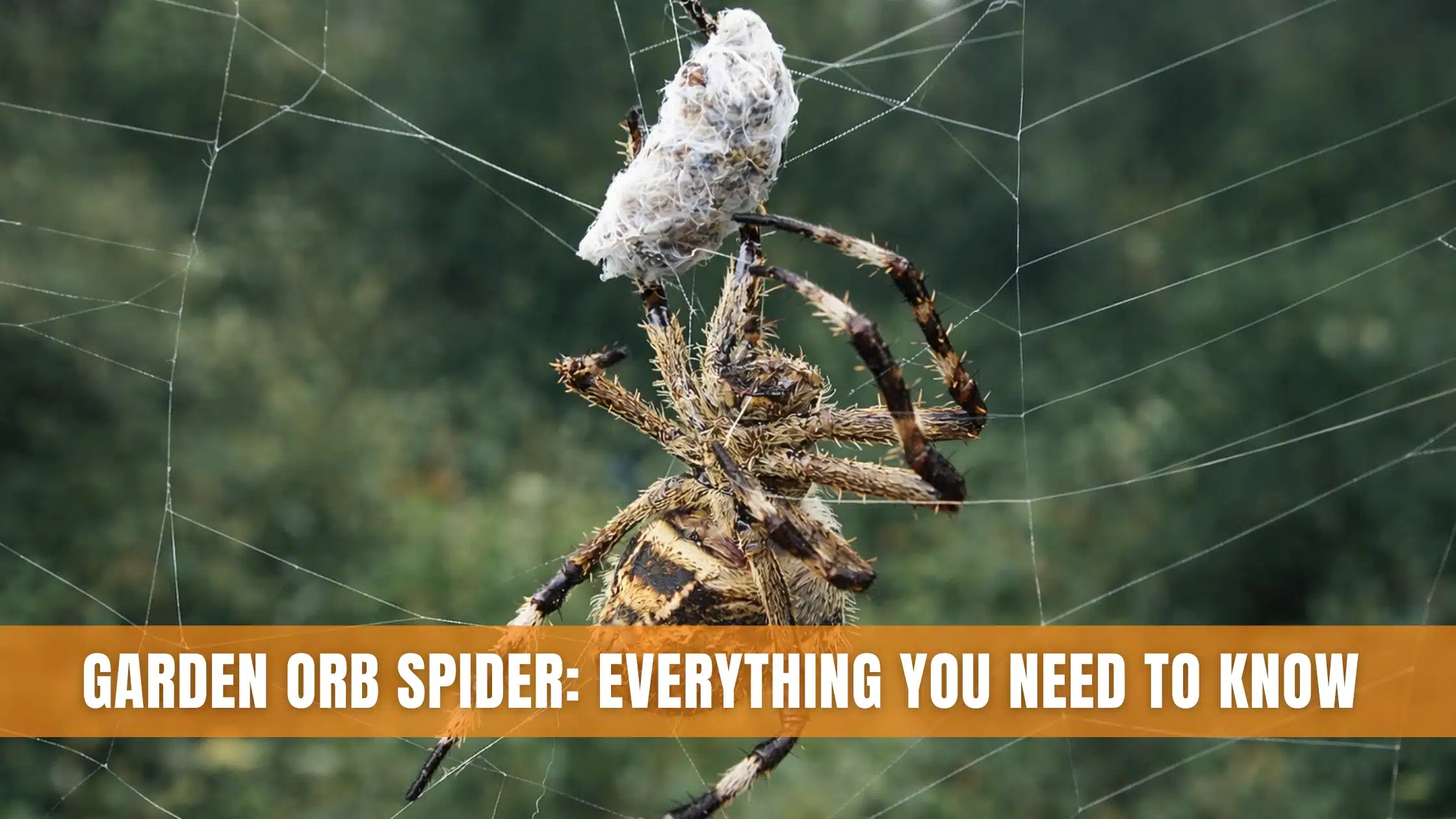
If you’ve noticed a large spider resting in the middle of a perfectly woven circular web in your garden, it’s likely a garden orb spider. These fascinating spiders are commonly found in gardens, parks, and natural landscapes, where they play an important role in maintaining a healthy environment. Rather than being harmful, garden orb spiders are beneficial predators that naturally reduce populations of flies, mosquitoes, moths, and other unwanted insects. Their impressive webs are designed to catch flying pests, making them valuable allies for gardeners. While these spiders rarely require removal, understanding when a professional spider pest control service is needed can help if you encounter dangerous spider species around your property. In this guide, you’ll discover everything you need to know about garden orb spiders, including how to identify them, their behaviour, habitat, life cycle, the benefits they provide, whether they pose any danger to humans, and practical tips for living alongside these remarkable creatures safely and peacefully.
What Is a Garden Orb Spider?
A garden orb spider is a member of the Araneidae family, one of the largest groups of orb-weaving spiders found across the world. These spiders are famous for creating large, perfectly circular webs that efficiently capture flying insects. They are commonly found in gardens, parks, forests, and other green spaces, where they play an important role in natural pest control and maintaining ecological balance.
Several well-known species of garden orb spiders include:
- Argiope aurantia – Also known as the black and yellow garden spider, commonly found in North America.
- Araneus diadematus – Commonly called the cross orb-weaver, widespread across Europe and North America.
- Eriophora transmarina – A popular garden orb weaver species found throughout Australia.
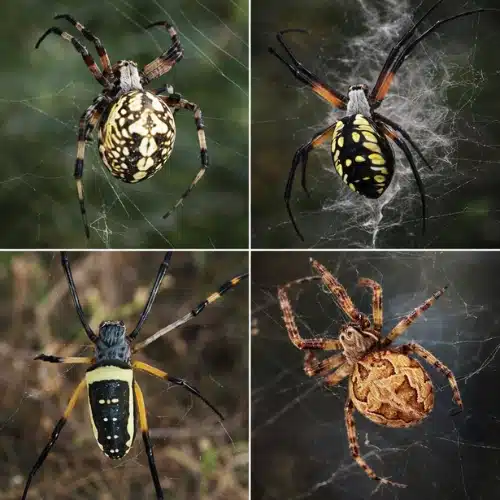
Although these species differ slightly in colour, size, and distribution, they all share several distinctive features that make identification easier. Most garden orb spiders have rounded or oval-shaped abdomens, striking body patterns, long banded legs, and build symmetrical orb-shaped webs that are rebuilt regularly.
Despite their intimidating appearance, they are generally harmless to humans and highly beneficial to gardens. By feeding on flies, mosquitoes, moths, beetles, and other flying insects, these spiders act as natural pest controllers, helping protect plants while reducing the need for chemical pesticides.
How to Identify a Garden Orb Spider
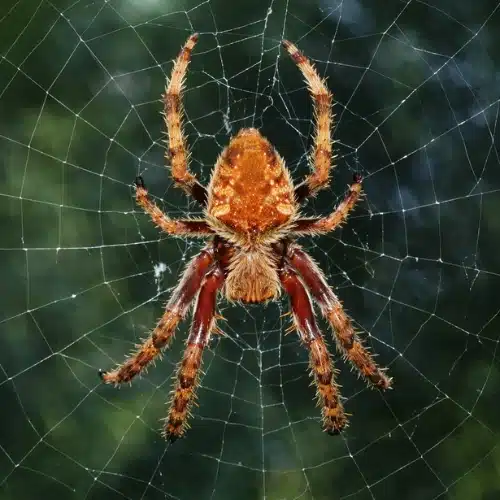
Identifying a garden orb spider is relatively easy once you know its distinctive features. These spiders are well known for their unique appearance and beautifully crafted circular webs, making them one of the easiest spider species to recognize in gardens and outdoor spaces.
Physical Characteristics
Most garden orb spiders share the following identifying features:
- Body Shape: Females are much larger than males and have a rounded, plump abdomen. Females typically measure 14–25 mm, while males are usually 5–9 mm long.
- Colour and Patterns: Their colours vary by species, ranging from brown and grey to vibrant yellow, black, orange, and white. Some species, such as Argiope aurantia, display bold yellow-and-black markings, while Araneus diadematus is recognised by its distinctive white cross pattern.
- Legs: They have eight long legs, often decorated with alternating light and dark bands.
- Eyes: Like most spiders, they possess eight small eyes arranged in two rows, although their eyesight is relatively poor.
Identifying Their Web
One of the easiest ways to identify a garden orb spider is by its impressive orb-shaped web. These large, circular webs often measure 30–60 cm across and consist of:
- Strong outer frame threads anchored to plants or structures.
- Radial threads extending from the centre like wheel spokes.
- Sticky spiral threads designed to capture flying insects.
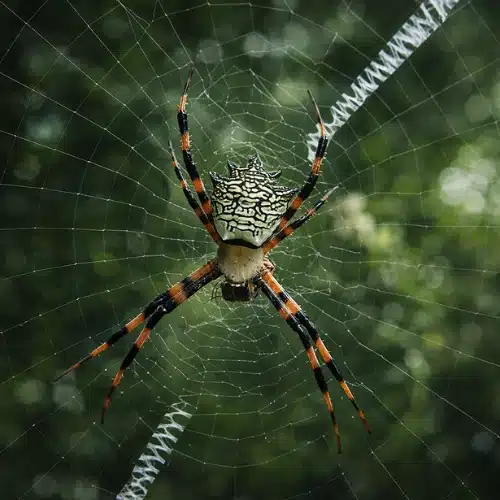
Some species also create a distinctive zigzag silk pattern, known as a stabilimentum, in the centre of the web. This unique feature may help attract prey, provide camouflage, or strengthen the web, making them one of nature’s most skilled web builders.
Where Do Garden Orb Spiders Live?
Garden orb spiders are adaptable and can be found in a wide range of habitats, including:
- Home gardens and backyards
- Meadows and grasslands
- Woodland edges and hedgerows
- Parks and nature reserves
- Agricultural fields
They prefer areas with abundant vegetation and insects, typically building their webs between shrubs, tall grasses, flower stems, and fence lines. You are most likely to spot them in late summer and autumn, when females have reached their full adult size after months of feeding and growth.
Garden Orb Spiders During Spider Season in Australia
In Australia, spider activity peaks noticeably during the warmer months. During spider season in Australia , which generally runs from late summer through autumn (February to May) — garden orb spiders are at their most visible and most active. This is the time of year when fully grown females sit prominently at the centres of their large webs, often in garden beds, verandas, and bushland edges across the country.
If you are an Australian gardener wondering why your garden suddenly seems full of large, impressive webs during this period, the garden orb spider is almost certainly the architect. Understanding their seasonal patterns helps homeowners manage any concerns calmly and avoid unnecessary panic. For a deeper look at why spider activity surges across the country each year, our guide on spider season in Australia covers everything you need to know.
Garden Orb Spider Behavior and Hunting
The garden orb spider is a skilled and patient predator that relies on its web rather than chasing prey. It creates a large, circular web and waits quietly for insects to become trapped in the sticky silk. This energy-efficient hunting method makes the garden orb spider one of nature’s most effective natural pest controllers.
How the Garden Orb Spider Hunts
When an insect becomes caught in the web, the spider reacts almost instantly by:
- Detecting vibrations through the web.
- Rushing toward the trapped prey.
- Wrapping the insect securely in silk.
- Delivering a venomous bite to immobilize it.
- Feeding immediately or storing the wrapped prey for later.
Its diet mainly includes flies, mosquitoes, moths, beetles, grasshoppers, and other flying insects, helping reduce common garden pests naturally.
Daily Habits
They are most active during the day, at dawn, or at dusk. It usually rests in the centre of its web with its legs spread across the silk strands to detect movement. Some species hide in nearby leaves at night while remaining connected to the web by a signal thread.
If the web becomes damaged by wind, rain, or large insects, the spider often eats the old silk to recycle its proteins before spinning a new web. Many garden orb spiders rebuild their intricate webs every night, ensuring they are always ready to catch fresh prey efficiently.
Garden Orb Spider Life Cycle
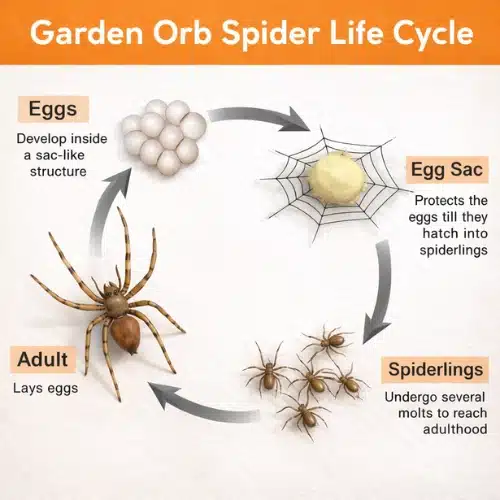
Mating
Mating typically occurs in late summer to early autumn. The much smaller male must approach the female cautiously, as she may mistake him for prey. He often plucks the web gently to signal his identity before mating. In many species, the male dies shortly after mating, either from natural causes or, in some cases, is consumed by the female — a behavior known as sexual cannibalism.
Egg Laying
After mating, the female produces one or more egg sacs, each containing hundreds of eggs. She wraps the eggs tightly in dense, protective silk and attaches the sac to nearby vegetation. A single female may lay between 400 and 1,400 eggs in one season.
Spiderlings
The eggs overwinter inside their protective sac. In spring, the spiderlings hatch and disperse using a behavior called ballooning — releasing a strand of silk into the wind and floating away to new locations. This allows the population to spread widely without competition.
Adult Life Span
Most garden orb spiders live for approximately one year. Females typically die with the arrival of cold weather after laying their eggs, and their offspring continue the cycle the following year.
Are Garden Orb Spiders Dangerous to Humans?
This is one of the most common questions people have, and the answer is reassuring: garden orb spiders pose very little risk to humans.
- They are not aggressive and will almost never bite unless directly handled or severely provoked.
- Their venom is designed for immobilizing small insects and is not medically significant to healthy humans.
- A bite, if it occurs at all, may cause mild, localised redness or swelling comparable to a bee sting — symptoms that typically resolve on their own within a day or two.
- Allergic individuals should exercise appropriate caution, as with any insect or arachnid encounter.
The best approach when encountering a garden orb spider is simply to admire it from a respectful distance and leave it undisturbed.
How Does It Compare to the Redback Spider?
Australian homeowners sometimes feel uncertain about which spiders are truly harmless and which require more caution. The garden orb spider is frequently encountered during the warmer months, and it is worth knowing how it differs from genuinely venomous species. The Redback Spider (Latrodectus hasselti), for example, is a medically significant spider native to Australia whose bite can cause serious symptoms and requires prompt medical attention.
Unlike the garden orb spider — which builds large, open webs in vegetation and is completely non-aggressive toward people — the Redback Spider tends to shelter in dark, dry, sheltered spots such as under outdoor furniture, inside sheds, and around rubbish bins. Knowing the difference between these species can help you stay safe in the garden. If you are unsure whether a spider you have encountered is a garden orb spider or a potentially dangerous species such as the Redback Spider, our guide on identifying common Australian spiders provides a clear visual comparison.
Benefits of Garden Orb Spiders in Your Garden
Garden orb spiders are enormously beneficial to gardeners and the wider ecosystem. Here is why you should welcome them:
Natural Pest Control
A single garden orb spider can catch and consume hundreds of insects per week. This makes it one of the most effective agents of natural pest control available to any gardener. The insects it targets include many notorious plant pests, such as aphids, whiteflies, leafhoppers, caterpillar moths, and fungus gnats , the same pests that can devastate vegetable patches and flower beds if left unchecked.
By allowing garden orb spiders to thrive in your outdoor space, you benefit from a free, chemical-free pest control system that works around the clock. This is particularly valuable for organic gardeners and those looking to reduce their environmental footprint.
Ecological Balance
Spiders are a vital link in the food chain. They control insect populations from below and serve as prey for birds, wasps, lizards, and small mammals above. A garden that supports a healthy spider population is an ecologically balanced garden.
Pollinator Protection
Unlike broad-spectrum pesticides that kill indiscriminately, the garden orb spider targets the insects that fly or jump into its web. While it does occasionally catch bees or butterflies, its overall impact on pollinator populations is far less harmful than chemical sprays.
How to Attract and Support Garden Orb Spiders
If you want to encourage garden orb spiders to take up residence in your outdoor space, consider the following practices:
- Reduce or eliminate pesticide use — chemicals kill the very insects spiders depend on for food, and they can directly harm spiders as well.
- Plant native wildflowers and grasses — dense, varied vegetation provides both web-building anchors and a thriving insect community for spiders to hunt.
- Leave garden debris undisturbed — leaf piles, log stacks, and dead plant stems provide shelter for spiders and their egg sacs.
- Install insect hotels — these structures support diverse invertebrate communities that include spiders and their prey.
- Avoid disturbing webs unnecessarily — a destroyed web is wasted energy for the spider. If you need to clear a path, relocate the spider gently rather than killing it.
Garden Orb Spider vs. Other Common Spiders
It is easy to confuse the garden orb spider with other web-building or garden-dwelling species. Here is a quick comparison, including the Redback Spider for Australian readers:
| Feature | Garden Orb Spider | Redback Spider | Cellar Spider | House Spider |
|---|---|---|---|---|
| Web Shape | Circular orb | Irregular, funnel-like | Irregular, tangled | Funnel or cobweb |
| Typical Location | Outdoor vegetation | Sheltered, dark spots | Corners of buildings | Indoors |
| Body Size | Medium to large | Small (female approx. 1 cm) | Small to medium | Small |
| Danger to Humans | Negligible | Medically significant | Negligible | Negligible |
| Benefit to Garden | High | Moderate | Moderate | Low |
The key takeaway is that the garden orb spider — while large and visually striking — is far less of a concern than the comparatively small Redback Spider, which shelters out of sight in places people unknowingly reach into.
Final Thoughts
The garden orb spider is an important part of a healthy garden ecosystem and one of nature’s most effective natural pest controllers. By feeding on flies, mosquitoes, moths, beetles, and other unwanted insects, it helps protect plants while reducing the need for chemical pesticides. Although its large size and intricate web may appear intimidating, they are generally harmless to humans and rarely become aggressive.
Understanding their behaviour and benefits can help you appreciate its valuable role in maintaining ecological balance. However, if you’re unsure whether you’ve found a harmless garden orb spider or a potentially dangerous species like the Redback Spider, it’s always best to seek professional advice.
Need expert spider control in Sydney? Contact EMK Termite & Pest Control Sydney for safe, reliable, and affordable spider inspections and treatments. Our experienced technicians provide fast, effective pest management solutions to keep your home or business protected. Call EMK Termite & Pest Control Sydney today for a free quote and enjoy a safer, spider-free property all year round!
Disclaimer: This article is intended for educational purposes. If you are unsure about a spider species in your area or experience a reaction following a spider bite, consult a medical professional or local pest control expert.
What Our Customers Had To Say
 Posted on Google
 Rami Anwer
Trustindex verifies that the original source of the review is Google.
We had such a great experience with the pest control service. From start to finish, everything was quick, easy and completely hassle-free. The team were professional, friendly and made the whole process so simple. We’re really happy with the results and the quality of the service we received from Eevil. I would definitely recommend EMK to anyone looking for a reliable pest control company!Posted on Google Rena NajimReally happy with the service today. Professional, friendly and did a great job. Would definitely recommend!Posted on Google
 David DavidEMK provided excellent pest control service. He was professional, punctual, and knowledgeable, explained the process clearly, and ensured it was safe for our family and pets. We saw great results straight away. Friendly, reliable, and highly recommended.Posted on Google
 Ann TranWe highly recommend EMK Termite and Pest Control Sydney. Great service, great prices, friendly and very accommodating. They are very thorough and take pride in their work. Cannot rate them high enough. 5 stars 🌟Posted on Google
 Charlton DurieI had these guys come and sort a termite issue. They got the job done. Thanks again!Posted on Google
 David MarshSuper happy with EMK for getting rid of such a horrible termite infestation! Professional and very friendly.Posted on Google
 Michael ZammitJust had EMK come out to do a rodent control treatment. The service and professionalism was superb!Verified by TrustindexTrustindex verified badge is the Universal Symbol of Trust. Only the greatest companies can get the verified badge who has a review score above 4.5, based on customer reviews over the past 12 months. Read more
Frequently Asked Questions About Garden Orb Spiders
Do garden orb spiders come indoors?
Why do garden orb spiders rebuild their webs every day?
How long does it take a garden orb spider to build its web?
When is spider season in Australia, and should I be worried?
What should I do if I find an egg sac in my garden?
Can garden orb spiders be kept as pets?
About The Author

EMK Termite & Pest Control Team
EMK Termite & Pest Control Team is a licensed and experienced pest control service provider based in Sydney, Australia. Our team specialises in termite treatment, cockroach control, spider control, and general pest management for residential and commercial properties.
With years of hands-on experience, we follow Australian safety standards and use proven, eco-friendly pest control methods to deliver long-lasting results. All content published on this website is written and reviewed by trained pest control professionals to ensure accuracy, safety, and real-world expertise.